
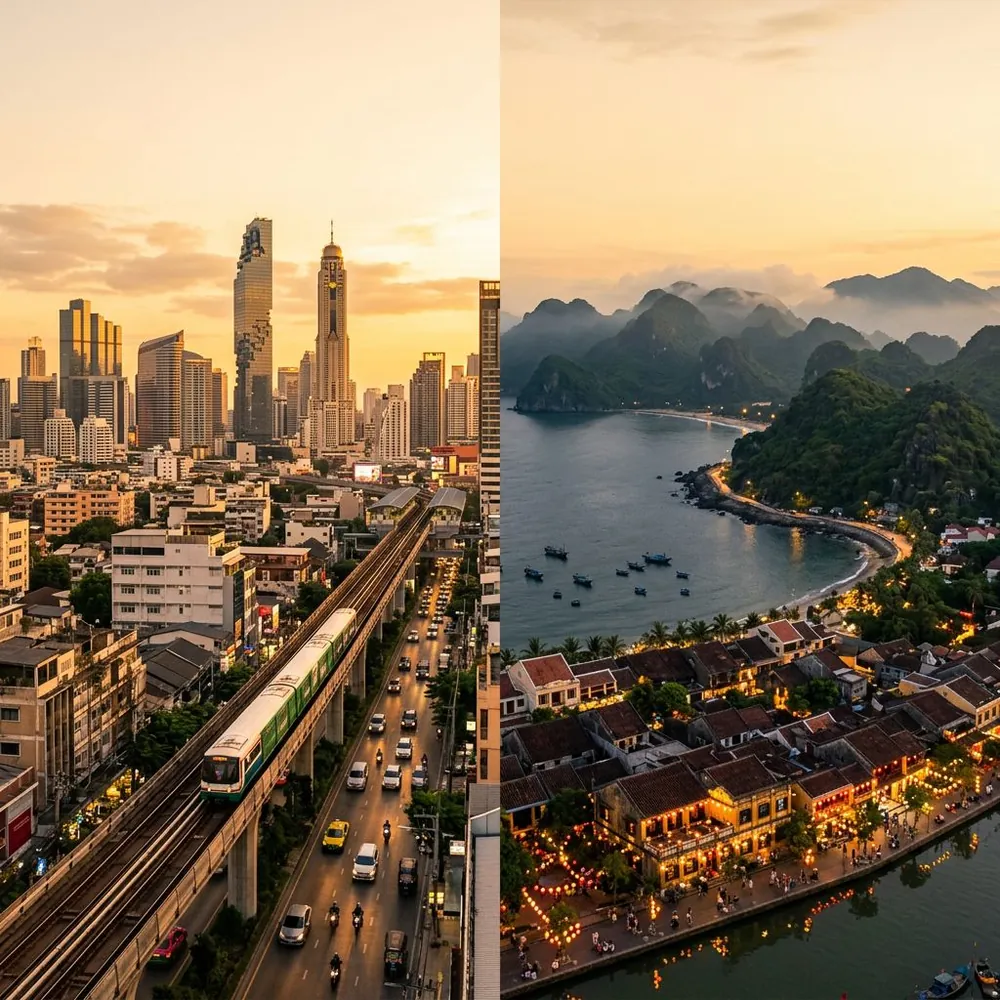
I have spent nine years in Southeast Asia and used both countries as a working base. The honest answer to "which is better" is that they are good at different things, and the right pick depends on what you are optimising for. Here is the fast version before we get into the detail.
Join the newsletter and get our free Southeast Asia Nomad Starter Kit: costs, visas, money, and the tools that actually matter. Plus on-the-ground updates as things change.
This is the category where Vietnam has the clearest edge. Across rent, food, and daily spending, Vietnam runs roughly 20 to 30 percent cheaper than comparable Thai cities. The gap is widest on accommodation and narrowest on imported goods and alcohol, where both countries charge a premium.
| Monthly cost (single nomad) | 🇻🇳 Vietnam | 🇹🇭 Thailand |
|---|---|---|
| 1BR apartment, central | $400 to $650 | $500 to $900 |
| Coworking hot desk | $70 to $110 | $100 to $150 |
| Local meal | $1.50 to $3 | $2 to $4 |
| Fast fibre internet | $10 to $18 | $15 to $30 |
| Scooter rental | $50 to $90 | $70 to $150 |
| Comfortable monthly total | $900 to $1,300 | $1,200 to $1,800 |
In practice, a budget nomad can live well in Ho Chi Minh City, Da Nang, or Hanoi for $800 to $1,000 a month. In Bangkok or Chiang Mai the same lifestyle lands closer to $1,200 to $1,500. The difference is real but not enormous, and it shrinks once you factor in the things Thailand does better, which we get to below.
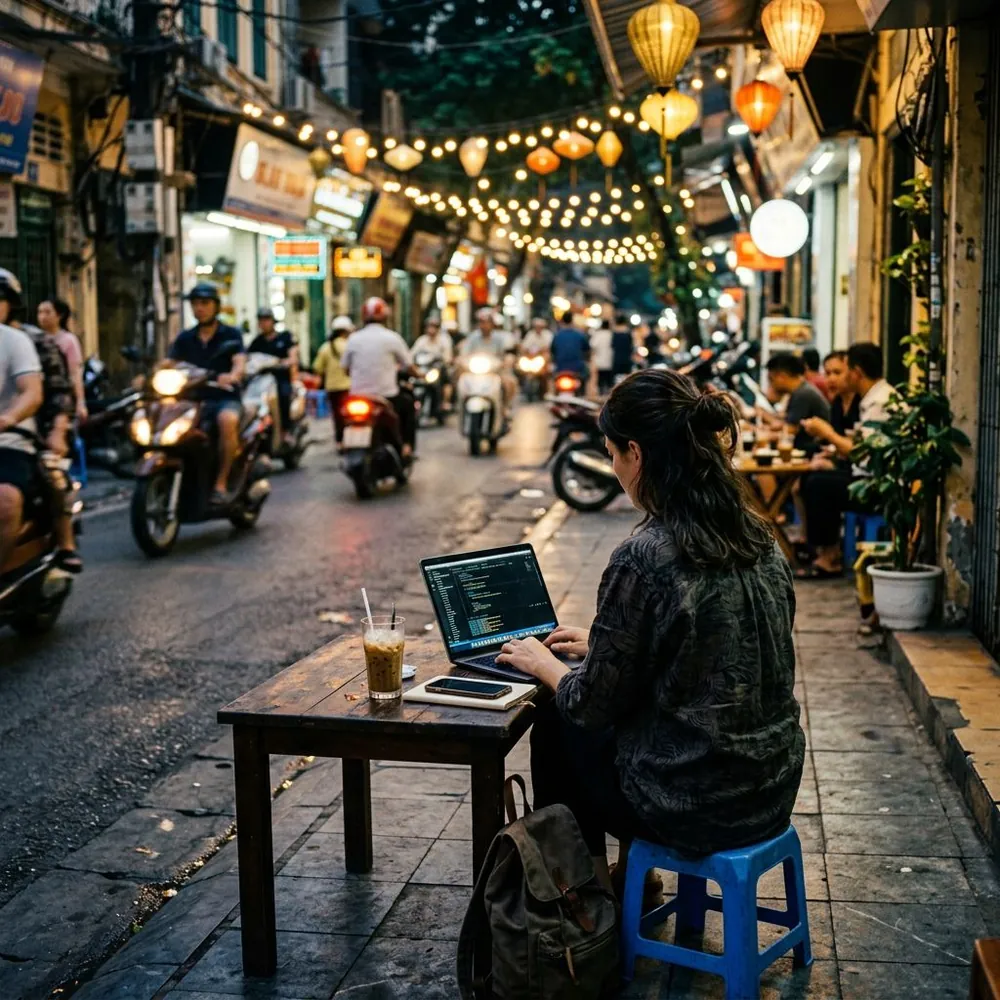
This is where Thailand pulls ahead for anyone who wants to actually settle. The two countries take opposite approaches.
Thailand's Destination Thailand Visa (DTV), launched in 2024, is aimed squarely at remote workers. It offers up to five years of validity with multiple entries and family inclusion, and each entry lets you stay 180 days, extendable once. The catch is that you generally apply from your home country or country of residence, and you need to show funds and some proof of remote work or activity. There is also the older tourist visa and visa-exemption route for shorter stays, though the days of endless back-to-back border runs are largely over as enforcement has tightened.
Vietnam keeps it simple and cheap. Citizens of most countries can apply online for a 90-day e-visa, valid for multiple entries, for a small fee, usually approved within a few business days. There is no dedicated digital nomad visa yet, so long-term nomads renew by doing a short regional hop and re-entering on a fresh e-visa. It is easy and inexpensive, but it means Vietnam is better suited to stays measured in weeks and months than in years.
For the full Thailand process, see my Thailand DTV visa guide, and for the Vietnam side, the Vietnam visa guide walks through the e-visa step by step.
Vietnam quietly has some of the best value internet in the world. Fibre in the major cities regularly delivers 100 Mbps and up for around 10 to 18 dollars a month, and even small neighbourhood cafes often run genuinely fast connections. Thailand's internet is also fast and reliable, especially on True and AIS fibre, but you tend to pay a little more for it.
On coworking, Thailand is ahead. Chiang Mai and Bangkok have a deep bench of dedicated spaces built up over a decade, from Punspace and Yellow in Chiang Mai to the many options across Bangkok. Vietnam's scene is growing fast, with strong clusters in Ho Chi Minh City's District 1 and Thao Dien, plus Da Nang, but it is younger and thinner outside the main hubs.
Thailand has the most established digital nomad community in Southeast Asia, full stop. Chiang Mai practically invented the modern nomad hub, and Bangkok has a large, layered scene of meetups, events, and long-termers. If your priority is landing somewhere and immediately plugging into a network, Thailand makes that easy.
Vietnam's community is smaller but growing quickly, especially in Da Nang, which has become a magnet for younger nomads and families drawn by the beach-city balance and lower costs. The vibe in Vietnam feels a little earlier-stage and less polished, which some people love and others find isolating. English is more widely spoken in Thailand's tourist and nomad areas, which lowers the day-to-day friction.
This one is close to a tie and mostly comes down to taste. Thai food is bold, spicy, and endlessly varied, and street food is a genuine competitive advantage for long-term nomads. My Thailand street food guide breaks down what everything actually costs. Vietnamese food is lighter, herb-forward, and arguably even cheaper, with pho, banh mi, and legendary coffee culture built into daily life for a dollar or two.
You will eat extraordinarily well in both. If you love heat and variety, Thailand edges it. If you prefer fresh, light, herby food and world-class coffee, Vietnam wins.
Thailand has a clear edge here. Its private hospitals, Bumrungrad and Samitivej in Bangkok being the famous ones, are genuinely world-class and draw medical tourists from across the globe, at a fraction of Western prices. Vietnam's healthcare is good in the major cities and improving, but for anything serious many expats still fly to Bangkok or Singapore.
In either country you want insurance. The single most common reason nomads end up in hospital in this region is a scooter accident, and one bad day without cover can wipe out months of savings. I use and recommend SafetyWing for most younger, healthy nomads because it covers both countries and can be bought after you have already left home.
Both countries run on scooters and ride-hailing apps. Grab works across both, and Vietnam adds Xanh SM, an all-electric option that is clean and cheap. Renting a scooter is cheaper in Vietnam, but traffic in Ho Chi Minh City and Hanoi is genuinely intense, arguably more chaotic than Bangkok. Thailand has the better long-distance infrastructure: more domestic flights, better trains, and easier island access.
Local banking is a headache for foreigners in both countries, and it is the friction point people underestimate most. Opening a local account can require a long-stay visa, a local address, and patience, and it is harder in Vietnam than in Thailand. ATM withdrawal fees are steep on both sides, typically 200 to 220 THB per withdrawal in Thailand and a similar cut in Vietnam.
The single best thing you can do before arriving in either country is set up a Wise account. It gives you real mid-market exchange rates, works at local ATMs, and lets you hold and convert THB and VND without the hidden markups that regular banks bury in the rate.
Wise gives you real exchange rates and low-fee ATM access for both THB and VND, so you are covered whether you land in Bangkok or Da Nang. Set it up before you leave home.
Get Wise Free →If you put a gun to my head: for a first long-term base in Southeast Asia, I would still start in Thailand. The DTV makes it legal to settle for years, the healthcare is a genuine safety net, and the community means you are never starting from zero. It is the lower-risk choice, which is why I based myself in Bangkok.
But Vietnam is where I send people who want to stretch a tight budget, who work fully remote and value fast cheap internet over everything, or who just want somewhere that still feels a bit undiscovered. Da Nang in particular is one of the best value nomad cities in the world right now.
The truth most comparison posts miss is that you do not have to choose forever. They are a 90-minute flight apart. Plenty of nomads base in Thailand on the DTV and spend a month or two a year in Vietnam when they want to reset their costs. If you can, do both. Start with whichever matches your situation today, and let the other one be your next move.
From $56/month, covers both Vietnam and Thailand plus 180+ countries. Can be purchased after you have already left home. Used by 100,000+ nomads.
Get SafetyWing →