
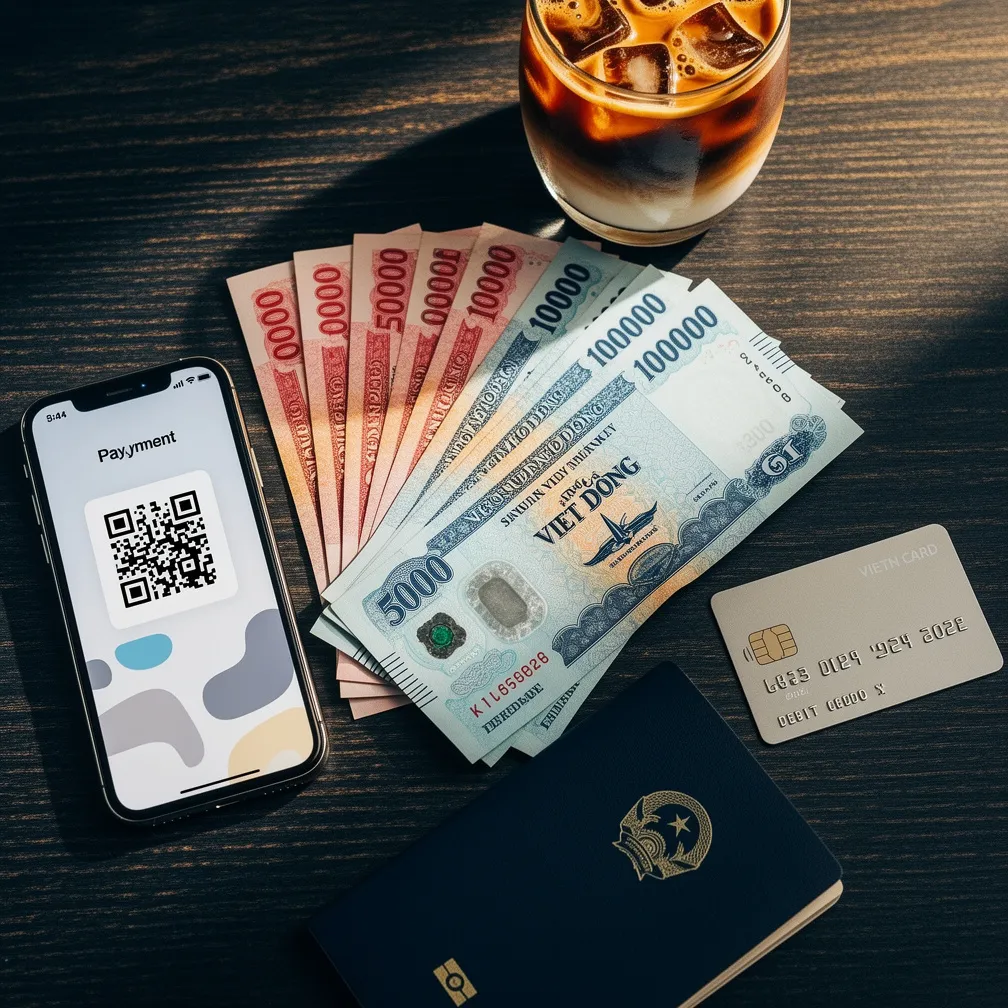
The Vietnamese Dong is one of the lowest-value currencies in the world. A cup of coffee costs 25,000-45,000 VND. A bowl of pho runs 40,000-60,000 VND. A nice dinner for two might be 500,000-800,000 VND. The numbers look insane at first, but you adjust quickly.
The quickest mental math trick: drop four zeros and divide by 2.6. So 100,000 VND is roughly $3.80 USD. Or for a faster (slightly less accurate) method, just drop four zeros and divide by 2.5. That makes 100,000 VND about $4. Close enough for street food decisions.
Vietnam uses polymer banknotes in denominations of 500,000 VND (the largest, about $19), 200,000, 100,000, 50,000, 20,000, 10,000, 5,000, 2,000, 1,000, and 500 VND. The 500,000 note is what ATMs usually dispense. The smaller notes (below 10,000) are rare and mostly exist as change from small vendors.
Unlike Thailand where every bank charges the same 220 baht fee, Vietnam's ATM fees vary wildly by bank. Some are free. Some charge flat fees. Some charge a percentage of your withdrawal that can cost you more than $10 on a single transaction. This table covers the major banks you will actually encounter.
| Bank | ATM Fee (Foreign Card) | Max Per Transaction | Notes |
|---|---|---|---|
| VPBank | Free | 10,000,000 VND (~$380) | Best option. Green/red branding. |
| ACB | Free | 3,000,000 VND (~$114) | Free but low limit per transaction |
| Eximbank | Free | 3,000,000 VND (~$114) | Less common, free when found |
| Saigon Bank | Free | 3,000,000 VND (~$114) | Rare outside HCMC |
| Vietcombank | ~50,000 VND (~$1.90) | 3,000,000 VND (~$114) | Most widespread ATMs in Vietnam |
| BIDV | ~3-4.6% of amount | 3,000,000 VND (~$114) | Percentage-based. Expensive. |
| Agribank | ~55,000 VND (~$2.10) | 3,000,000 VND (~$114) | Common in rural areas |
| Vietinbank | ~55,000 VND + 4.4% | 3,000,000 VND (~$114) | Flat fee plus percentage. Worst option. |
| TPBank | ~3.3% of amount | 5,000,000 VND (~$190) | Used to be free. Changed June 2025. |
| Techcombank | ~50,000 VND (~$1.90) | 3,000,000-5,000,000 VND | Best mobile app for residents |
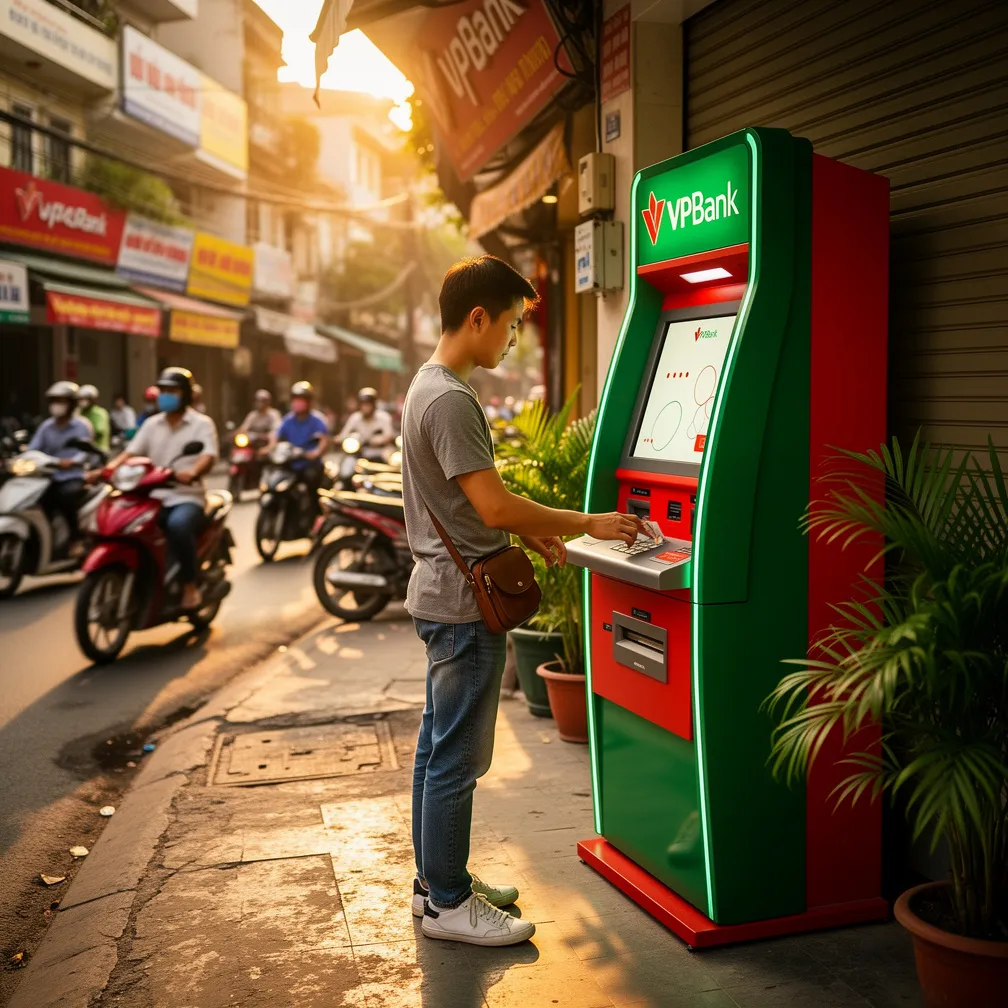
Step 1: Find VPBank ATMs. Search "VPBank ATM" on Google Maps wherever you are. VPBank has branches in every major city, with the most coverage in Hanoi and Ho Chi Minh City. Da Nang and Hoi An have them too. The ATMs have bright green and red branding. You can withdraw up to 10,000,000 VND per transaction with zero fees, and there is no VPBank-imposed daily cap. Your home bank's daily limit is the only restriction.
Step 2: If no VPBank nearby, use ACB or Eximbank. Both are fee-free but cap withdrawals at 3,000,000 VND per transaction. You can do multiple transactions back to back if you need more cash.
Step 3: When stuck with a paid ATM (Vietcombank, Agribank), withdraw the maximum. Since most charge a flat fee of 50,000-55,000 VND regardless of amount, withdraw the full 3,000,000 VND to minimize the per-dollar fee percentage.
Vietnam is rapidly going cashless, especially in HCMC and Hanoi. QR code payments are accepted at most restaurants, coffee shops, convenience stores, and increasingly at street vendors. Three platforms dominate the market.
MoMo is Vietnam's biggest e-wallet and the app you will see QR codes for most often. It handles payments, peer-to-peer transfers, bill payments, ride-hailing, and food delivery. Think of it as Vietnam's version of Thailand's PromptPay, but run by a private company instead of the government.
The catch for foreigners: MoMo requires a Vietnamese phone number to register. You can sign up with a foreign passport, but to actually load money into the wallet you need either a Vietnamese bank account linked to the app or to top up at a physical agent location (Circle K, Ministop, VinMart+). Without a local bank account, topping up in person is your only option, and the agents sometimes have limits or require showing your passport.
ZaloPay is integrated with Zalo, the messaging app that basically everyone in Vietnam uses (think WhatsApp but Vietnamese). If you install Zalo to communicate with locals (landlords, coworkers, friends), ZaloPay is built right in.
The catch for foreigners: ZaloPay requires a Vietnamese ID or passport to register. Foreign passports work for sign-up, but like MoMo, you need a Vietnamese bank account to fully fund the wallet. Without one, you are limited to receiving money from others and occasional small promotions.
VNPay is not an e-wallet you download. It is a payment infrastructure layer that connects most Vietnamese banks. When you see a VietQR code at a shop, you scan it with your Vietnamese bank's mobile app (Vietcombank, Techcombank, BIDV, etc.) and pay directly from your account. No separate wallet needed.
This is the system that matters most for long-term residents. Once you have a Vietnamese bank account, VietQR codes become your primary payment method. They are accepted everywhere that MoMo is, and then some.
Card acceptance has improved significantly in Vietnamese cities, but it is still not universal. Here is what to expect.
Where cards work: Hotels, Western restaurants, upscale Vietnamese restaurants, coffee chains (Highlands Coffee, The Coffee House), malls, supermarkets (Vinmart, Lotte Mart), international chains, and ride-hailing (Grab accepts Visa/Mastercard).
Where cards do not work: Street food vendors, local markets, most small Vietnamese restaurants, motorbike rentals, most accommodation under $20/night, small shops, and anything outside the tourist districts of major cities.
The 3% surcharge problem: Many Vietnamese merchants add a 2-3% surcharge on top of credit card payments. This is technically against Visa/Mastercard merchant agreements, but it is extremely common in Vietnam. Ask before paying with a card if the price was quoted in cash.
If you need to send money to yourself (from your home bank to a Vietnamese account) or receive money from clients, Wise is the best option by a wide margin.
| Method | Fee on $5,000 Transfer | Speed | Rate |
|---|---|---|---|
| Wise (from balance) | ~$6-8 | Under 20 seconds (74% of transfers) | Mid-market (real rate) |
| Wise (bank debit) | ~$28-45 | Under 24 hours | Mid-market (real rate) |
| Bank wire (SWIFT) | $150-265 | 3-5 business days | Bank rate (1-3% markup) |
| Western Union | $40-80 | Minutes (cash pickup) | 2-4% markup |
Wise delivers directly to Vietnamese bank accounts. No cash pickup, no mobile wallets. Your recipient (or you, if you have a local account) needs a VND bank account. Transfers are capped at 499,999,999 VND per transfer (roughly $19,000-20,000 USD). If you need to send more, split into multiple transfers.
For volume senders: if you transfer over $25,000 in a calendar month across all currencies, Wise automatically applies a discounted fee rate.
Wise gives you the real mid-market exchange rate with no hidden markup. Transfer to Vietnamese bank accounts in seconds. Set it up before you land.
Get Wise Free →Unlike Thailand where SuperRich and other exchange shops give great rates, Vietnam's exchange landscape is different.
Airport exchange counters: Terrible rates. Avoid if possible. If you must exchange on arrival, do the minimum to cover a taxi and first meal.
Gold shops (Tiệm vàng): These are the best option for cash exchange in Vietnam. Gold shops in District 1 (HCMC), the Old Quarter (Hanoi), and tourist areas in Da Nang offer rates close to the mid-market rate. They accept USD, EUR, GBP, AUD, and sometimes other currencies. No paperwork, no passport copy needed in most cases. Just walk in, agree on a rate, and exchange.
Banks: Banks offer reasonable exchange rates but require paperwork and your passport. The process takes 15-30 minutes compared to 2 minutes at a gold shop. Banks are the safest option for large amounts but overkill for daily exchange needs.
Hotels: Convenience premium of 2-5% built into the rate. Only use as a last resort.
If you are staying in Vietnam for more than a month or two, a local bank account changes everything. It unlocks VietQR payments, lets you link MoMo and ZaloPay, and makes receiving salary or freelance payments easy.
The hard truth: most major Vietnamese banks require a visa or residence permit valid for at least 12 months. Tourist visas are almost universally rejected as of 2026. The State Bank of Vietnam's regulations set this baseline, and banks have gotten stricter about enforcement over the past year.
| Bank | Best For | English Support | Min Deposit |
|---|---|---|---|
| Vietcombank | Salary, international transfers | District 1, Thao Dien branches | ~1,000,000 VND |
| Techcombank | Best mobile app, daily spending | Good in major cities | ~1,000,000 VND |
| HSBC Vietnam | Multi-currency, international banking | Excellent | Higher balance required |
| Standard Chartered | Premium banking, multi-currency | Excellent | Higher balance required |
Vietnam's deposit insurance covers up to 125,000,000 VND (roughly $4,750) per depositor per bank. If you have more than this amount in savings, spread it across multiple banks. For example, 200,000,000 VND split between Vietcombank and Techcombank means your full balance is covered. The same 200,000,000 VND at a single bank leaves 75,000,000 VND uninsured.
Starting July 2026, the State Bank of Vietnam requires biometric authentication (facial recognition) for any single transfer exceeding 10,000,000 VND (roughly $380) or total daily transfers over 20,000,000 VND (~$760).
This means you need to register your biometrics at your bank branch before making large transfers. If you already have a bank account, visit your branch and ask to register for biometric authentication on your app. New account holders will have this set up during account opening.
This does not affect ATM withdrawals or card payments. It only applies to bank-to-bank transfers initiated through mobile banking apps.
Extremely unlikely in 2026. Major banks (Vietcombank, BIDV, Techcombank) stopped accepting tourist visas in 2025. Some smaller banks (TPBank, ACB) occasionally make exceptions, but success rates are below 10% and come with severe restrictions: payment account only, no interest, higher fees, and mandatory closure within 3-6 months. The real solution is converting to a work visa or obtaining a TRC.
For a typical day in a major city, 500,000-1,000,000 VND ($19-38) covers street food, coffee, local transport, and small purchases. Keep 2,000,000-3,000,000 VND on hand if you are traveling to rural areas or smaller cities where card acceptance drops significantly. Do not carry more than 5,000,000 VND unless you have a specific reason.
It depends where you are. HCMC and Hanoi are rapidly going cashless, especially among younger Vietnamese who use MoMo and VietQR for everything. But step outside the major cities and cash is still king. Street food, local markets, motorbike rentals, and smaller guesthouses almost always require cash. Carry both options.
Yes. Grab works across Southeast Asia with the same account. Your linked Visa/Mastercard will work. However, GrabPay credits from Thailand do not transfer. You will need to pay by card or cash in Vietnam.
Vietnam legalized cryptocurrency in January 2026 with a 0.1% transaction tax taking effect July 2026. For the full breakdown, read our Vietnam Crypto Guide.
You must declare amounts over 5,000 USD (or equivalent in other currencies) and over 15,000,000 VND when entering Vietnam. There is no limit on how much you can bring, but undeclared amounts above the threshold can be confiscated.
Support is growing but still limited. Some larger merchants in HCMC and Hanoi accept contactless payments, but do not rely on it. Always have a physical card and cash as backup.
🔒 Using banking apps on Vietnamese WiFi?
Encrypt your financial data on shared networks. A VPN protects every transaction from cafe and coworking WiFi snoops.
Get NordVPN - Up to 75% Off →We use and recommend NordVPN. Affiliate link. We may earn a commission at no extra cost to you.
Join the newsletter and get our free Southeast Asia Nomad Starter Kit: costs, visas, money, and the tools that actually matter. Plus on-the-ground updates as things change.
From $56/month. Covers Vietnam and 180+ countries. Can be purchased after you have already left home. Medical evacuation included.
Get SafetyWing →