
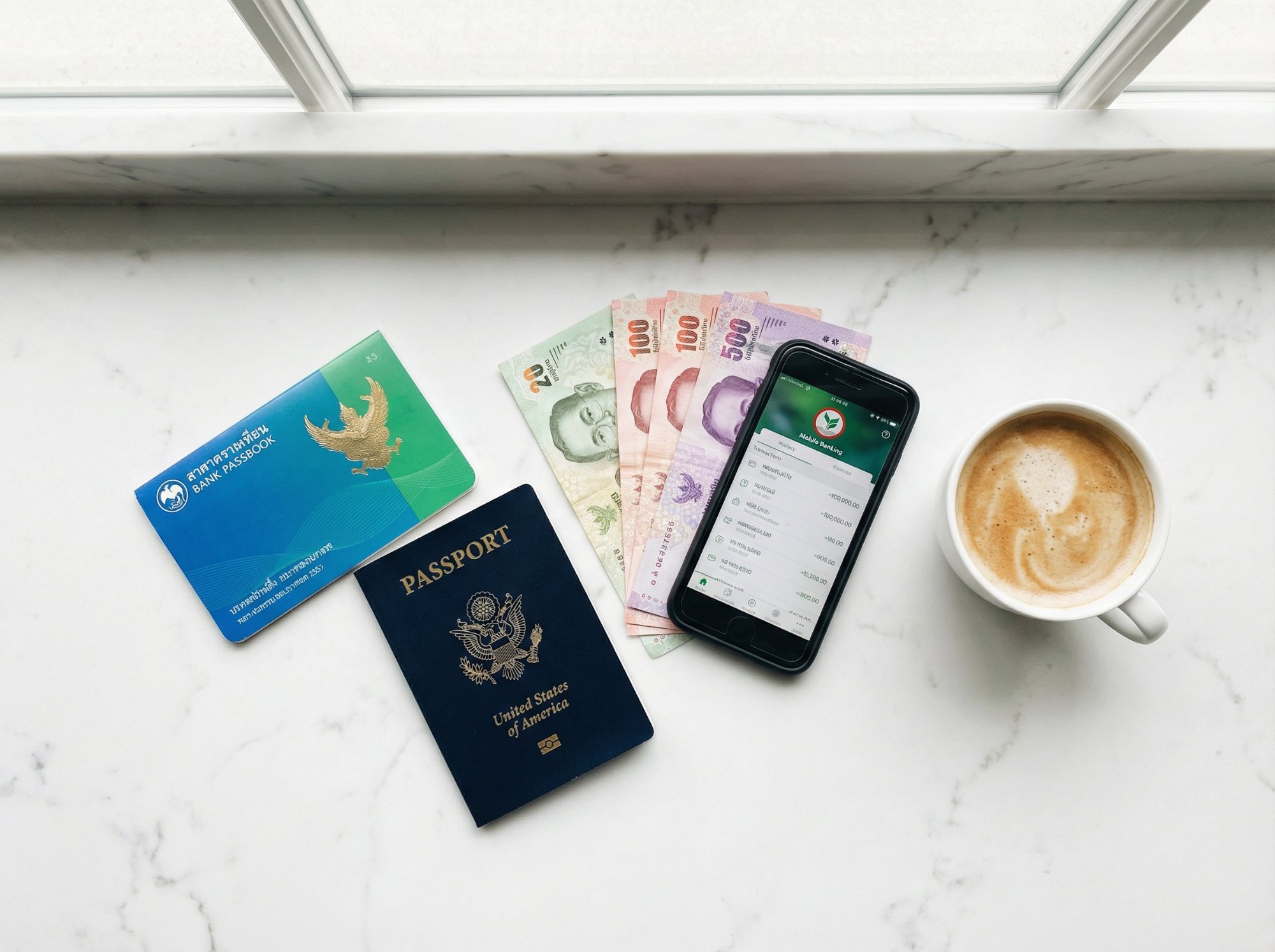
If you've read blog posts from 2023 or earlier about opening a Thai bank account, throw out everything you know. The landscape has shifted dramatically and most online guides are dangerously outdated.
Starting in 2024 and becoming strictly enforced throughout 2025, Thai banks implemented sweeping new requirements under pressure from the Bank of Thailand (BOT), the Anti-Money Laundering Office (AMLO), and the National Broadcasting and Telecommunications Commission (NBTC). The result: opening a bank account has gone from a simple walk-in task to a high-level compliance procedure.
The biggest changes at a glance:
I bank with SCB (Siam Commercial Bank) at a branch on Rama 4 in Bangkok. I have a work permit through my kindergarten teaching job, which made my process straightforward. But I've watched the landscape change dramatically for friends and colleagues without work permits, and the information below reflects the reality on the ground in 2026, not what was true two years ago.
To understand why banking became so difficult, you need to understand the mule account crisis.
Thailand has been hit hard by online scam networks, call center fraud, phishing operations, and investment scams run largely from border towns in Myanmar and Cambodia. These criminal operations rely on Thai bank accounts to move money, and they were using accounts opened by tourists and short-term visitors as untraceable "mule accounts."
The numbers are staggering. In the first half of 2025 alone, the Bank of Thailand suspended approximately 3 million accounts for suspected mule activity. In Q2 2025, scam losses exceeded 6 billion baht (roughly $188 million USD). The Thai government elevated the crackdown to a "National Agenda."
In November 2025, authorities completed verification of over 120 million phone numbers linked to banking. Of those, around 30.9 million numbers (about 26%), primarily SIM cards opened by foreigners before 2023, had mismatched mobile banking and SIM card registration details. Users had until April 30, 2025 to update their information or face mobile banking suspension.
This is why banks are now so cautious with foreign applicants. Every account opened is a potential liability, and bank staff are personally at risk if an account they approved is used for fraud.
Since late 2025, all major Thai banks require biometric verification when opening an account. This means:
This biometric data is critical because it's used for ongoing banking security. When you transfer more than 50,000 THB via mobile banking (more on this below), your face is scanned against the photo taken at the branch. It's an integrated system designed to ensure the person using the account is the person who opened it.
This is where most outdated guides get it wrong. The list of accepted visas has shrunk considerably.
| Visa Type | Who It's For | Bank Account? |
|---|---|---|
| Non-Immigrant B | Work permit holders | ✅ Most reliable, easiest approval |
| Non-Immigrant O | Marriage, retirement, dependents | ✅ Yes, may need marriage cert or pension proof |
| Non-Immigrant ED | Students (university, language school) | ✅ Yes, need enrollment letter from school |
| LTR | Long-Term Resident visa | ✅ Yes |
| Thailand Privilege (Elite) | Premium visa holders | ✅ Yes, VIP treatment, all banks accept |
| DTV | Digital nomads, remote workers | ⚠️ Mostly rejected, see warning below |
| Tourist visa | Short-term visitors | ❌ Rejected everywhere |
| Visa exempt (30/60 day) | Arrivals without visa | ❌ Rejected everywhere |
The bottom line: banks want to see a visa that proves you have a legitimate, long-term reason to be in Thailand. Work permits, marriage, education, and retirement all pass this test. Tourist entries, including the DTV, increasingly do not.
This is probably the most important thing in this entire guide, because so many digital nomads arrive in Thailand on a DTV assuming they'll be able to open a bank account.
Bangkok Bank, previously the most foreigner-friendly option, has stopped opening accounts for DTV holders. Reports from expat forums and legal firms show DTV holders having existing accounts reviewed, frozen, or even closed. Some are losing access to mobile banking apps entirely.
If you're a digital nomad planning to stay in Thailand long-term and need a bank account, the DTV alone may not be enough. Your best options are:
The full banking walkthrough (including exact branch recommendations and a visa comparison across 5 countries) is in The Ultimate Digital Nomad Guide to Southeast Asia. 34 pages of real data from 9 years of living here.
Get the Guide, $9.99 →| Bank | Foreigner-Friendly? | App Quality | Best For |
|---|---|---|---|
| Bangkok Bank | Most accepting (but no longer for DTV) | Good | Best first attempt without work permit. Largest branch network. |
| Kasikorn (KBank) | Good | Excellent (K PLUS) | Great app. Good for ED visa holders and CBD branches. |
| SCB | Stricter | Excellent (SCB EASY) | Usually requires work permit. Enforces July 2025 document requirements strictly. |
| Krungthai | Moderate | Good | Government-linked. Good for ED visa holders near government areas. |
My recommendation: Start with Bangkok Bank at a large, central branch. The branches near BTS Asoke, Silom, and Siam have staff who process foreign applications regularly. If Bangkok Bank says no, try KBank next.
I use SCB because I have a work permit. The SCB EASY app is excellent, transfers, QR payments, bill payments all work seamlessly. But since SCB now strictly enforces the July 2025 requirements (including biometric face registration for foreign customers starting September 20, 2025), I wouldn't recommend it as your first attempt without a work permit.
Join the newsletter and get our free Southeast Asia Nomad Starter Kit: costs, visas, money, and the tools that actually matter. Plus on-the-ground updates as things change.
Bring everything. Having a single missing document means another wasted trip.
1. Original passport, At least 6 months validity. They'll photocopy the photo page, visa page, and entry stamp. Make sure your electronic chip is working (most modern passports have one, look for the chip symbol on the cover).
2. Valid long-term visa, Non-Immigrant B, O, ED, LTR, or Privilege. Not a tourist visa, visa exemption, or (at most banks) DTV.
3. Work permit (if you have one), Makes everything dramatically easier. If you don't have one, you'll need stronger supporting documents.
4. Proof of Thai address, In order of reliability:
5. Thai phone number registered in your name, This is absolutely critical. Your SIM card must be registered under your passport at the mobile provider (AIS, True, or DTAC). Since late 2024, Thailand requires biometric face/fingerprint verification for SIM card registration too. The name on your SIM registration must exactly match your banking identity. Any mismatch will block your application or trigger account suspension later.
6. Initial deposit, Usually 500-2,000 THB in cash.
7. Photocopies of everything, Thai banks rarely accept digital documents on phones. Bring physical photocopies of your passport photo page, visa page, and entry stamp.
Go to a large, central branch, ideally near a BTS station in a business or expat area. Branches near Silom, Asoke, Siam, and Phrom Phong have staff experienced with foreign applications. Never go to a small residential branch. Staff at smaller branches are often unfamiliar with the process and will reject you out of uncertainty.
Timing: Go on a weekday, 10-11am. Avoid Monday mornings (busiest) and Friday afternoons. Take a queue number for "open new account" as soon as you arrive.
Tell the staff you want to open a savings account (banchee awk-som / บัญชีออมทรัพย์). Present your passport, visa, and all supporting documents immediately. Having everything organized and ready signals that you're a serious, prepared applicant, not a random tourist trying their luck.
This is the new step that didn't exist before 2025. The bank will:
This biometric data is stored and used for all future identity verification, including the face scan required for large mobile transfers.
Fill out the application forms (staff will guide you). Deposit your initial amount (500-2,000 THB). You'll receive your account number and passbook immediately. Your debit card is typically issued same-day or mailed within 1-2 weeks.
Don't leave until mobile banking is set up. The staff will help you download and configure the app:
Mobile banking activation at the branch ensures your biometric face data is linked to the app from day one. If you try to set it up later at home, you may get locked out and have to return to the branch anyway.
Link your Thai phone number to your bank account via PromptPay. This is Thailand's national QR payment system. Once activated, you can pay at virtually every restaurant, street vendor, 7-Eleven, and shop by scanning a QR code. It's free, instant, and used by everyone. This is what transforms your daily life in Thailand.
This happens regularly. Even well-prepared applicants get rejected. Don't give up.
Try another branch of the same bank. Policies vary between branches and individual staff members. Many expats report being rejected at one Bangkok Bank branch and approved at another the same day. Silom and Asoke branches tend to have the highest success rates for foreigners.
Try a different bank. If Bangkok Bank says no, try KBank. If KBank says no, try Krungthai.
Get a Certificate of Residence. If your rental contract wasn't accepted as proof of address, go to immigration and get one. It takes 3-4 days and is the one document banks trust unconditionally.
Go back at a different time. Different staff, different shifts, different outcomes. The manager on Tuesday might be more experienced with foreign applications than the one on Thursday.
Be persistent but polite. Thai culture values politeness above everything. Being frustrated or aggressive guarantees rejection. A smile, patience, and a wai go a long way. Bring a Thai-speaking friend if you can, it makes a significant difference.
The best way to send money to your Thai account is through Wise (formerly TransferWise). Transfer from your home currency to THB at the real mid-market exchange rate. Money typically arrives within minutes.
With your Thai bank account and PromptPay active, you can:
This catches many people off guard. As of mid-2025, the Bank of Thailand mandated biometric face verification for:
When triggered, your banking app activates your phone's front camera and asks you to scan your face. It compares this to the biometric photo taken when you registered at the branch. If it doesn't match, the transfer is blocked.
For most day-to-day living, you won't hit this limit. Rent payments are the main exception, if your rent is over 50,000 THB, you'll need to do the face scan each time, or split into smaller transfers.
If you can't open one yet, maybe you're on a tourist visa or DTV while you figure out a longer-term visa, you can still manage:
It works, but it's clunky. Once you get a qualifying visa, make banking a priority, it transforms your quality of life.
This banking walkthrough is one section of The Ultimate Digital Nomad Guide to Southeast Asia. The full 34-page guide covers 4 countries, coworking spaces, healthcare with hospital comparisons, visa strategies, teaching English salaries, monthly budgets, nightlife, and more. Plus 3 bonus resources.
Get the Guide, $9.99 →Opening a Thai bank account in 2026 is harder than it has ever been. The mule account crisis triggered regulations that made what was once a walk-in task into a serious compliance procedure. Biometric requirements, SIM card verification, and the DTV rejection are all new realities that most online guides haven't caught up with yet.
But it's still absolutely possible with the right visa, the right branch, and the right documents. My process at SCB with a work permit was smooth, passbook in hand within an hour, mobile banking set up before I left, PromptPay running the same day. Once you're set up, daily life in Thailand becomes dramatically easier.
Get your visa sorted first. Then gather every document on the checklist. Then walk into a large central branch with confidence, patience, and a smile.
📚 Related NomadAgent Guides
Thailand ATM Fees Guide 2026 (Includes Kasikorn PAY&TOUR Tourist Card)
How to Rent an Apartment in Bangkok 2026
Thailand Digital Nomad Visa Guide 2026
🎯 Explore Thailand Activities & Tours