
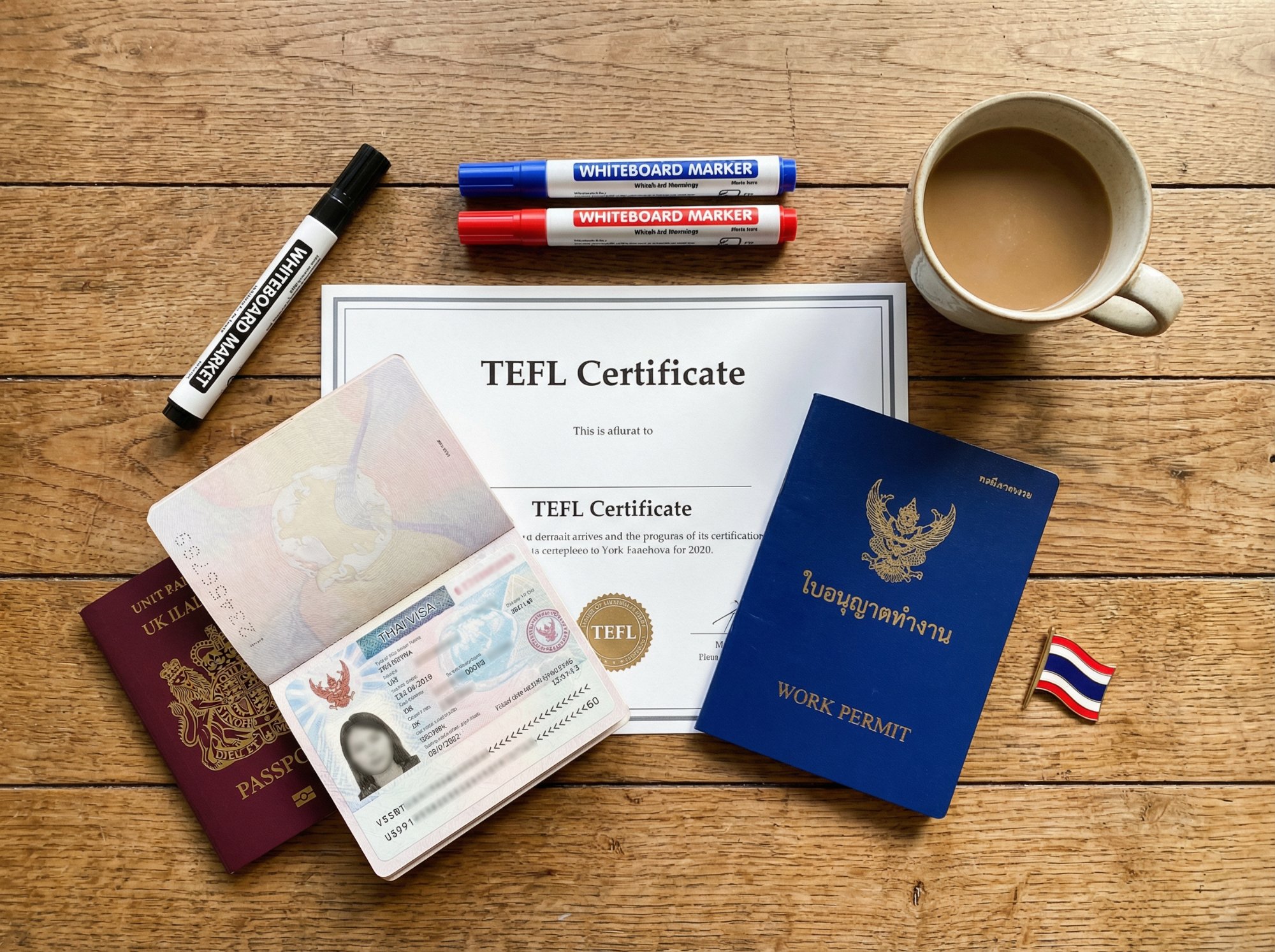
Three things, in sequence: a Non-Immigrant B visa, a work permit, and a Khurusapha teaching licence. Each depends on the one before it, and a decent school files most of it on your behalf.
Here's the reality: the paperwork side of teaching in Thailand is the part that stops most people. Not because it's impossibly hard, but because the information online is outdated, contradictory, and scattered across forums from 2018. This guide reflects the actual 2026 processes, including the new e-Work Permit system and updated Khurusapha requirements.
As a teacher, you need to manage four legal obligations simultaneously:
1. Non-Immigrant B Visa, Your entry visa that permits you to work in Thailand. Applied for at a Thai embassy/consulate before entering, or converted from a tourist visa (sometimes).
2. Work Permit, Legal authorization to work for a specific employer. Now handled through the e-Work Permit digital system. Must be obtained within 30 days of starting work.
3. Teaching License (Khurusapha), Authorization from the Teachers Council of Thailand to teach. You start with a temporary permit and work toward a full license through the 7-module training system.
4. 90-Day Reporting (TM47), Ongoing immigration requirement to report your address every 90 consecutive days you're in Thailand.
Your school handles most of this process, but you need to understand it so you can push back when things go wrong, and trust me, things go wrong. Schools lose paperwork, forget deadlines, and sometimes try to cut corners. Being informed is your best protection.
The Non-Immigrant B visa is your entry visa for employment in Thailand. You cannot legally work on a tourist visa, visa exemption, or DTV (Digital Nomad Visa), even if you have a job offer.
Once you accept a job offer, your school prepares the following documents for your visa application:
You apply at a Thai embassy or consulate. The most common options:
| Location | Processing Time | Notes |
|---|---|---|
| Your home country | 5-10 business days | Best option if you're not already in Asia |
| Vientiane, Laos | 2-3 business days | Most popular for teachers already in Thailand. "Visa run" destination. |
| Savannakhet, Laos | 2-3 business days | Alternative Laos option, less crowded |
| Penang, Malaysia | 2-3 business days | Good option for southern Thailand |
If you're already in Thailand on a tourist visa or visa exemption, you'll need to leave the country to apply for your Non-B visa. This is called a "visa run." The most common route is Bangkok → Vientiane, Laos:
Budget option: Overnight bus from Bangkok to Nong Khai (400-600 THB), cross the Friendship Bridge to Vientiane, apply at the Thai embassy. Total: approximately 6,000-8,000 THB including accommodation.
Flight option: Fly Bangkok → Vientiane (2,000-4,500 THB one way on AirAsia or Lao Airlines). Apply and return. Total: approximately 10,000-15,000 THB.
Timeline: Allow 3-4 days minimum. Submit on Day 1, collect on Day 2 or 3. Some embassies are slower during peak periods.
| Detail | Information |
|---|---|
| Visa fee | 2,000 THB (single entry) / 5,000 THB (multiple entry) |
| Initial validity | 90 days from entry |
| Extension | Extended to 1 year at immigration once work permit is issued |
| Application | Online via thaievisa.go.th or in person at embassy |
| Re-entry permit | Required if you leave Thailand and want to keep your visa valid (1,000 THB single / 3,800 THB multiple) |
Thailand launched the e-Work Permit system in October 2025, replacing the old physical "blue book" with a fully digital process. This is one of the biggest changes for teachers in years.
1. School submits application online, Your employer files through eworkpermit.doe.go.th. They upload your documents (passport, degree, photos, employment contract).
2. Identity verification via ThaiID app, You need to register through the ThaiID app for digital identity verification. Download it from the App Store or Google Play and complete the registration process.
3. One biometric visit, You visit your local Department of Employment office once for face, iris, and fingerprint scanning. This appointment takes approximately 12 minutes.
4. Digital permit issued, Your work permit is issued digitally. You receive a credit card-sized permit with a QR code that links to your digital record. No more carrying the blue book.
| Detail | Information |
|---|---|
| Fee | 3,000 THB for 1 year |
| Portal | eworkpermit.doe.go.th |
| Physical format | Credit card-sized with QR code |
| Biometric visit | One visit, ~12 minutes, at Department of Employment |
| Paper submissions | Still accepted until April 28, 2026 (extended due to technical glitches) |
| Employer-tied | Yes, switching schools requires a new work permit application |
The Teachers Council of Thailand (known as Khurusapha or KSP) regulates all teachers in Thailand, including foreigners. You cannot legally teach without a KSP license or temporary permit.
If you have a bachelor's degree in any field (not specifically education), you start with a temporary permit:
| Detail | Information |
|---|---|
| Type | Temporary Teaching License (Waiver) |
| Validity | 2 years |
| Fee | 1,000 THB |
| Payment | Via KSP Self-Service portal or at any 7-Eleven |
| Maximum renewals | 3 waivers total (6 years maximum on temporary permits) |
| Employer-tied | Yes, digitally anchored to your specific school |
| Application | Through the KSP Self-Service portal |
The temporary permit gets you started, but it's not a long-term solution. You can only get three waivers (6 years total), and then you must have a full teaching license. This is where the 7-module training system comes in.
The Thai Professional Development Institute (TPDI) 7-module training program is how foreign teachers earn a full Thai teaching license. It replaced the old system of submitting foreign teaching certificates for equivalency.
The program consists of 7 modules, each requiring 60 hours of training (420 total hours). Modules are completed through a combination of online learning and mandatory weekend Zoom seminars.
| Module | Topic | Hours |
|---|---|---|
| 1 | Professional Ethics & Teacher Conduct | 60 |
| 2 | Educational Psychology & Child Development | 60 |
| 3 | Thai Culture & Society in Education | 60 |
| 4 | Educational Policy & Administration | 60 |
| 5 | Classroom Management & Assessment | 60 |
| 6 | Digital Technology in Education | 60 |
| 7 | Teaching Methodology & Practice | 60 |
All training is managed through khuruplatform.ksp.or.th, also accessible via the OnePlatform app (available on iOS and Android). You register, enroll in modules, complete coursework, and track progress through the platform.
Login: Use your passport number as your username. You'll also need your Khurusapha ID number, look it up on the KSP license search portal using your passport number.
Module order: You can complete modules in any order. Pick whatever fits your schedule, you don't have to go 1 through 7 sequentially.
Online learning: Video lectures, reading materials, quizzes, and assignments, completed on your own schedule.
Weekend Zoom seminars: Mandatory live sessions, typically held on Saturdays. These include discussions, presentations, and practical demonstrations. Attendance is tracked.
Registration: Opens annually, typically February-March (check the TPDI Facebook page for exact dates). You can also express interest via kspregis.thaijobjob.com.
Cost: 3,200 THB per module + a one-time 1,000 THB processing fee. Total for all 7 modules: 23,400 THB ($688). Payment via QR code mobile banking.
Support: TPDI Call Center at 0-2257-7149 (press 3), Mon-Fri 8:30 AM - 5:30 PM. LineID: @Thaijobjob. Email: info@kurupatana.ac.th
Understanding the license progression is crucial for long-term planning as a teacher in Thailand:
2-year validity. Up to 3 renewals (6 years maximum). Tied to your employer. No modules required, just a degree and a job offer.
Awarded after completing all 7 modules of the TPDI training and applying for knowledge certification. Valid for 2 years. Significant upgrade, recognized across schools. Note: If you've completed at least 4 out of 7 modules, Khurusapha provides a "P-License extension" that bypasses the old 3-waiver cap, a critical lifeline for teachers who started late.
The full Thai teaching license. Requires: P-License + at least 1 year of teaching experience in Thailand + passing the NIETS Board Examinations. Valid for 5 years.
Reserved for veteran educators with 15+ years of experience and a Master's degree in Education. The top tier, rarely pursued by TEFL teachers but worth knowing about for long-term career planning.
To receive the B-License, you must pass three board exams administered by NIETS (National Institute of Educational Testing Service):
| Exam | Content |
|---|---|
| Teaching Profession | Pedagogy, classroom management, assessment, educational law |
| Thai Language & Culture | Basic Thai language, Thai customs, cultural understanding |
| Digital Technology | Educational technology, digital literacy, online teaching methods |
Board exams are held twice yearly (exact dates announced by NIETS). They are challenging but passable with preparation, the Thai Language & Culture exam is the one most foreign teachers find difficult. Study groups exist in Bangkok and online.
Every foreigner staying in Thailand on a long-term visa (including Non-B) must report their address to immigration every 90 consecutive days. This is separate from your visa and work permit, it's an immigration tracking requirement.
Portal: tm47.immigration.go.th (Version 2026)
First report: Must be done in person at your local immigration office. This cannot be done online.
Subsequent reports: Can be done online through the TM47 portal.
TDAC integration: The system is now linked to TDAC (Thailand Digital Arrival Card). You need your TDAC reference number for online reporting.
Window: 15 days before to 7 days after your due date.
The TM30 is a notification that your landlord or accommodation provider must file with immigration within 24 hours of you moving in. It confirms where you're living. This isn't your responsibility to file, it's your landlord's, but you need it for visa extensions and 90-day reporting.
In practice, hotels and serviced apartments file TM30 automatically. For private rentals, you may need to remind (or push) your landlord to file it. Some landlords don't know about the requirement. If your landlord won't file, you can do it yourself at immigration, but bring your lease agreement.
As of 2024, Thailand replaced the old paper TM6 arrival/departure card with the Thailand Digital Arrival Card (TDAC). You fill it out online before arriving in Thailand at tdac.immigration.go.th.
Your TDAC reference number is now required for various immigration processes, including online 90-day reporting. Save this number, you'll need it repeatedly.
Here's a realistic timeline for a teacher who accepts a job offer in March for a May start:
School provides invitation letter, WP.3 form, and supporting documents for your visa application. You prepare notarized/apostilled copies of your degree and background check if you haven't already.
Apply at Thai embassy in your home country or do a visa run to Vientiane/Savannakhet. Processing takes 2-5 business days depending on location.
Enter Thailand with your Non-B visa. Your initial stay is typically 90 days. Complete TDAC before arrival.
School submits your e-Work Permit application through the online portal. You register on ThaiID app and attend one biometric appointment (~12 min). Digital permit issued.
School applies for your temporary teaching license through KSP Self-Service portal. Pay 1,000 THB fee. Usually processed within 1-2 weeks.
With work permit in hand, apply to extend your Non-B visa to 1 year at your local immigration office. Fee: 1,900 THB.
Complete your first 90-day report in person at immigration. Subsequent reports can be done online.
Once settled, register for the 7-module TPDI training through the OnePlatform app. Begin working toward your P-License and eventually B-License.
Here's what the entire legal process costs for a first-year teacher:
| Item | Cost (THB) | Cost (USD) |
|---|---|---|
| Non-B Visa fee (single entry) | 2,000 | $59 |
| Visa run travel (budget, to Laos) | 6,000 - 8,000 | $176 - $235 |
| Work Permit (1 year) | 3,000 | $88 |
| Khurusapha temporary permit | 1,000 | $29 |
| Visa extension (to 1 year) | 1,900 | $56 |
| Re-entry permit (multiple) | 3,800 | $112 |
| Document legalization/apostille | 3,000 - 5,000 | $88 - $147 |
| TPDI 7-module training (all modules) | 23,400 | $688 |
| Total (Year 1, without modules) | 20,700 - 24,700 | $608 - $726 |
| Total (including all 7 modules) | 44,100 - 48,100 | $1,297 - $1,415 |
Some schools reimburse part or all of these costs. Ask during your interview, it's a reasonable negotiation point, especially for the visa run and work permit fees.
My paid guide includes side-by-side visa cost breakdowns for Thailand, Vietnam, Bali, Cambodia, and the Philippines, including teaching-specific visa paths, timelines, and cost calculators.
Get the Guide, $9.99 →Join the newsletter and get our free Southeast Asia Nomad Starter Kit: costs, visas, money, and the tools that actually matter. Plus on-the-ground updates as things change.
A Non-Immigrant B visa. You apply for it before arriving or convert from a tourist entry in-country, and your school provides the supporting employment documents.
Not legally. Teaching on a tourist visa or without a permit is a labour violation and carries fines, deportation and a re-entry ban.
It is the Thai teaching licence issued by the Teachers Council. You need it to teach legally at a Thai school, and new teachers usually start on a temporary permit while working towards it.
Yes. Anyone on a long stay visa must report their address to Immigration every 90 days using form TM47, in person, by post or online.
The legal side of teaching in Thailand looks overwhelming on paper, but in practice it's a series of manageable steps, especially when your school guides you through the process. The key is understanding what needs to happen, when, and what it costs so you're never caught off guard.
The 2026 changes, particularly the e-Work Permit system, have actually simplified things compared to even a few years ago. No more lugging around the blue book. No more half-day visits to the Department of Employment for renewals. The digital system has its glitches, but it's a clear improvement.
If you haven't read Part 1 yet, it covers everything about requirements, salaries, types of schools, where to find jobs, and what daily life as a teacher actually looks like:
Teaching is one of the best entry points to life in Southeast Asia. My 34-page guide covers teaching, banking, healthcare, coworking, monthly budgets, and visa strategies across 5 countries. Plus 3 bonus resources.
Get the Guide, $9.99 →📚 Related NomadAgent Guides
Part 1: TEFL Requirements, Salaries & Getting Hired
How to Open a Thai Bank Account in 2026
Thailand Digital Nomad Visa (DTV) Guide 2026
🎯 Explore Thailand Activities & Tours
Wise gives you real exchange rates with minimal fees across Thailand, Vietnam, Malaysia, Bali, and the Philippines. Set it up before you leave home.
Get Wise Free →